




API Idempotency: How to Prevent Sending the Same Message Twice
Imagine that a customer completes an order on your platform.
Your backend calls a messaging API to send an SMS confirmation. The messaging service receives the request, but your application experiences a network timeout before receiving the API response.
Your system assumes the request failed and retries it.
The problem is that the original request may already have succeeded.
The customer may now receive the same confirmation message twice.
This is exactly the type of problem API idempotency is designed to address.
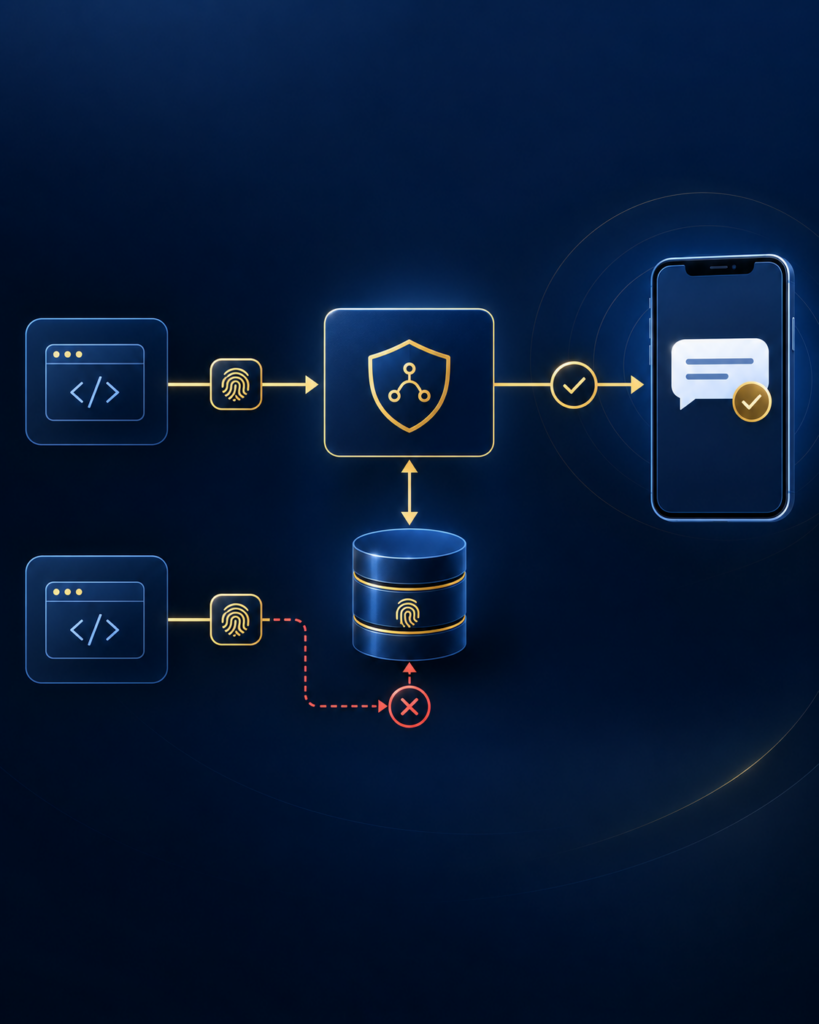
What Is API Idempotency?
Idempotency is a property where performing the same operation multiple times has the same final effect as performing it once.
In a messaging workflow, this means your application should be able to distinguish between:
- A genuinely new message request.
- A retry of a request that has already been processed.
Google Cloud describes idempotency as an important property for resilient distributed systems, particularly when intermittent network failures or timeouts can cause requests to be repeated.
Why Do Duplicate Messages Happen?
Duplicate SMS or notification requests can appear even when the developer never intentionally calls the messaging API twice.
Network Timeouts
Your application sends a message request.
The provider processes it successfully, but the HTTP response never reaches your application.
From the application’s perspective, the status is unknown.
A retry can therefore create a second message.
Automatic Retries
Applications commonly retry requests following transient errors such as server failures or rate limits.
However, not every API operation is automatically safe to retry.
For example, Twilio notes that operations such as sending an SMS are not inherently idempotent and that retrying certain failed POST requests may cause recipients to receive multiple messages.
Message Queues
Modern applications often process notifications through background workers and message queues.
Many distributed systems use at-least-once delivery, which prioritizes making sure an event is delivered but means the same event can occasionally arrive more than once.
The consumer therefore needs a strategy for identifying already processed events.
Concurrent Requests
Two application workers may also try to process the same event almost simultaneously.
Without database constraints, locking, or another concurrency-control strategy, both workers may conclude that the message has not yet been sent.
The result can be two outbound messages.
What Is an Idempotency Key?
An Idempotency Key is a unique identifier associated with one logical operation.
A typical key could be a UUID:
550e8400-e29b-41d4-a716-446655440000
When the request is processed for the first time, your system records that identifier.
If the same operation is retried with the same key, the receiving system can recognize that the operation has already been handled.
Instead of creating another side effect, it can return the previously recorded result.
AWS recommends idempotency tokens as a way to safely handle repeated mutating requests and advises systems to track the processing state associated with each token.
A Messaging Example
Assume order:
ORDER-92831
needs one SMS confirmation.
You could associate that logical operation with:
ORDER-92831-CONFIRMATION-SMS
The workflow becomes:
- Receive the send request.
- Check the idempotency identifier.
- If the identifier is new, reserve it.
- Send the message.
- Store the messaging result and message ID.
- If the same identifier appears again, do not create another send operation.
A deliberately new message should receive a new identifier.
For example, if the user requests another verification code later, that is a separate business operation and should not reuse the previous idempotency key.
How to Implement Idempotency in Messaging Integrations
Generate a Stable Unique Identifier
A UUID is a common option.
You may also derive the identifier from a business operation such as an order, transaction, notification, or verification session.
The important requirement is consistency:
The same retry must use the same identifier.
Generating a new key on every retry defeats the purpose of idempotency.
Store Processing State
A database or persistent cache can keep information such as:
idempotency_keystatusmessage_idcreated_atresponse
Possible statuses might include:
processing
sent
failed
Check Before Sending
Before creating a new outbound messaging operation, check whether the same idempotency key has already been processed.
If it has completed successfully, return the existing result rather than sending another message.
Protect Against Race Conditions
A simple database read followed by an insert may still fail when multiple workers process the same event concurrently.
Consider database uniqueness constraints, atomic transactions, locking, or another appropriate concurrency mechanism.
Idempotency vs. Deduplication
The terms are related but not identical.
Idempotency means repeating an operation does not create an additional side effect.
Deduplication means identifying duplicate items and ignoring or removing them.
An idempotency key can be used to implement deduplication, but event systems can also deduplicate based on unique event or message IDs.
For example, Twilio recommends recording event IDs and discarding events that have already been processed when consuming potentially duplicated events.
Messaging API Best Practices
Do not blindly retry every failed request.
Use a controlled retry policy such as exponential backoff where appropriate.
Keep the same idempotency identifier for retries of the same operation.
Avoid using message text alone as your duplicate identifier because identical text can legitimately be sent multiple times.
Instead, associate deduplication with the business event.
Examples include:
- Order confirmation.
- Payment notification.
- OTP session.
- Shipment status update.
- Appointment reminder.
Common Mistakes
One of the most common mistakes is assuming that a missing API response means the operation definitely failed.
In distributed systems, the request may have succeeded even though the acknowledgement was lost.
Another mistake is generating a different idempotency key on every retry.
Timestamp-only identifiers can also be problematic. AWS specifically lists timestamps as an idempotency-key anti-pattern because clock differences and concurrent requests can lead to inaccuracies.
When Is Idempotency Especially Important?
Messaging idempotency becomes particularly valuable for automated communication such as:
- OTP messages.
- Order confirmations.
- Payment alerts.
- Delivery notifications.
- Appointment reminders.
- CRM-triggered messages.
- ERP notifications.
- Webhook-driven messaging.
- Background jobs.
As messaging volume and automation increase, retry and duplicate handling become important parts of a reliable integration architecture.
Conclusion
Preventing duplicate messages is not only a campaign-management concern.
It begins with reliable API design.
Messaging integrations should assume that network failures, retries, duplicate events, and concurrent execution can happen.
By combining stable idempotency identifiers, persistent operation state, deduplication, concurrency protection, and controlled retry strategies, developers can significantly reduce the risk of accidentally sending the same message to a customer more than once.
OurSMS provides API-based messaging integration options for businesses that need to connect communication workflows with applications, CRM systems, ERP platforms, and other internal systems. Developers can explore the OurSMS SMS API and developer resources when designing automated messaging workflows.