




Real-Time Marketing During the Roshn Saudi League: How Businesses Can Use SMS and WhatsApp to Drive Engagement
A football match may kick off at 8 p.m., but for a marketer, the opportunity can begin hours earlier.
One customer may be deciding where to watch the match. Another may be preparing to order dinner. Someone else may be browsing an online store before kickoff.
These moments create opportunities for real-time marketing: connecting a marketing message with something customers are already thinking about or doing.
The 2026–27 Roshn Saudi League started on August 13, 2026 and is scheduled to continue until May 29, 2027, with 306 matches across 34 rounds. That gives Saudi businesses an entire season of potential match-related marketing moments rather than a single short-lived campaign.
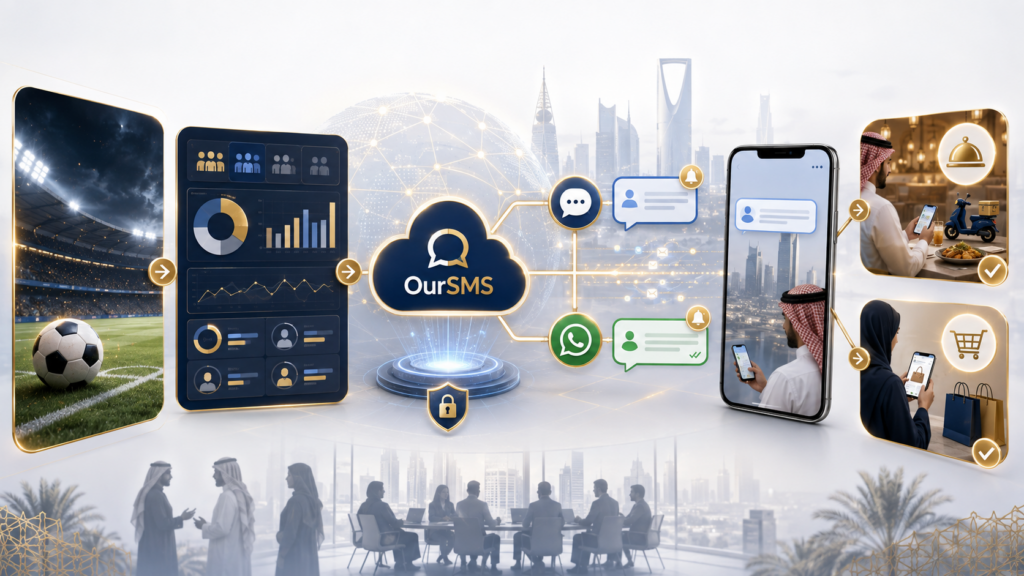
What Is Real-Time Marketing?
Real-time marketing connects a campaign to a current event, situation or customer moment.
Instead of sending:
“Order today and get a discount.”
A restaurant might send:
“Getting ready for tonight’s match? Order early and have your meal ready before kickoff.”
The offer may be similar, but the context is different.
The second message connects the promotion to something that is already relevant to the customer.
SMS and WhatsApp can support this strategy because businesses can schedule messages or connect messaging to their applications and business systems through APIs. OurSMS provides SMS, OTP and WhatsApp APIs alongside developer integrations and Webhooks.
Why Football Matches Create Marketing Moments
The important question is not:
“How can our brand talk about football?”
It is:
“How does the match affect the customer behavior that matters to our business?”
For a restaurant, the opportunity could be ordering before kickoff.
For a café, it may be reservations.
For an e-commerce store, it could be a limited-time evening promotion.
For a delivery app, the objective might be reactivating customers who have not ordered recently.
This turns football from a trending topic into a useful campaign timing signal.
Before the Match
Restaurants and delivery businesses do not need to wait until kickoff.
A campaign sent earlier can help customers plan ahead.
For example:
“Tonight’s match is getting close. Order early and get everything ready before kickoff. Today’s offer is available for a limited time.”
The strongest campaigns create a clear relationship between the message timing and the requested action.
During the Match
Marketing during the game should be handled carefully.
Customers are watching the match, so excessive messaging can quickly become intrusive.
In some cases, halftime may create an appropriate short window:
“The second half starts soon. Order now and use tonight’s match offer before it ends.”
Real-time marketing does not mean sending a promotion after every major moment.
Sometimes sending fewer, better-timed messages creates the stronger customer experience.
After the Final Whistle
The opportunity does not necessarily end with the match.
Restaurants operating late can create post-match offers, delivery apps can run short promotions, and retailers can continue engaging customers around the broader sports occasion.
That creates three possible campaign windows:
Before → During → After
This does not mean sending all three messages to every customer. Segmentation allows different groups to receive the message that is most relevant to them.
Ideas for Restaurants and Cafés
Restaurants are particularly well positioned for match-time campaigns.
Potential ideas include early-order promotions, group meal bundles, time-limited deals, customer reactivation campaigns and branch-specific offers.
The real advantage is not simply the discount.
It is combining offer + audience + timing.
E-Commerce and Delivery Apps
Retailers can use the same strategy without selling football merchandise.
An electronics retailer could focus on improving a customer’s match-viewing setup.
A grocery service could promote items customers may want at home.
A delivery app could focus on convenience.
A loyalty program could send different offers based on previous customer behavior instead of distributing one generic discount to everyone.
SMS or WhatsApp?
Neither channel is automatically better for every campaign.
SMS works well for short, direct and time-sensitive messages.
For example:
“Tonight’s offer ends at 11 p.m. Use code MATCH when ordering.”
WhatsApp Business Platform can support richer and more conversational customer journeys. Meta requires businesses to obtain user opt-in before initiating business messaging, and marketing communications are subject to WhatsApp’s template and messaging policies.
The better strategy is therefore often not SMS versus WhatsApp, but choosing the right channel for the right customer journey.
Do Not Send the Same Offer to Everyone
Segmentation is one of the most valuable parts of real-time marketing.
Businesses can potentially segment audiences based on previous purchases, location, branch, customer activity, loyalty status and previous campaign engagement.
A restaurant, for example, could target customers who regularly order during evening hours rather than sending the same match promotion to its entire database.
Automate the Campaign
The strategy becomes more scalable when the marketing team does not need to manually execute every message.
OurSMS provides APIs for SMS and WhatsApp integrations, with developer tools including Webhooks and delivery reporting.
A campaign workflow might look like:
CRM → customer segment → campaign logic → OurSMS API → SMS/WhatsApp → results
This can be particularly useful for e-commerce platforms, delivery apps, loyalty systems and CRM-driven businesses.
Best Practices
Start with a commercial objective.
Do you want more pre-match orders? Reservations? Reactivation? Purchases from a particular segment?
Then choose your audience, timing and communication channel.
Keep the offer easy to understand, provide one clear call to action and state the relevant deadline.
For WhatsApp campaigns, businesses should also ensure the necessary customer opt-in is in place before sending business messages.
Common Mistakes
The biggest mistake is sending a football-themed message simply because a match is happening.
If the event does not create a meaningful reason for the customer to take action, adding a football emoji will not make the campaign relevant.
Other mistakes include sending too many messages during the same match, launching an offer too late, failing to segment customers and not measuring what happened after the message was delivered.
Brands should also avoid suggesting an official relationship with a club or competition when no such relationship exists.
Conclusion
Marketing during Saudi League matches is not about reacting to every scoreline.
It is about understanding what customers may need during a particular moment and delivering a relevant offer at the appropriate time.
With the 2026–27 Roshn Saudi League running through May 29, 2027, businesses have a long season in which to test, measure and improve match-related campaigns.
A restaurant might test pre-match offers. An online retailer might experiment with evening campaigns. A delivery app could combine match timing with CRM data to reactivate customers.
The principle remains simple:
Don’t send a message just because there is a match. Send when you have something relevant to offer in that moment.
OurSMS can support businesses with SMS campaigns, SMS API integrations and WhatsApp Business API solutions for building automated customer communication journeys.