




Message Fatigue in 2026: How Businesses Can Send Less on WhatsApp and SMS and Get Better Results
A customer bought from your store last week.
On Saturday, you send an SMS promotion.
On Sunday, they receive the same offer on WhatsApp.
Tuesday brings a reminder.
Thursday brings a “last chance” message.
Then another campaign starts a few days later.
From the marketing team’s perspective, those may look like four opportunities to convert.
From the customer’s perspective, they may be four additional reasons to ignore the brand.
This is message fatigue.
In 2026, the most important messaging question is no longer:
“How can we send more?”
A better question is:
“How do we make every message worth the space it occupies on the customer’s phone?”
What Is Message Fatigue?
Message fatigue occurs when customers receive too many communications—or too many similar communications—until each additional message becomes less valuable.
The customer may not immediately unsubscribe.
First, they ignore the message.
Then they stop opening future messages.
Eventually, they may opt out, block the business, or report the communication as irrelevant.
Reaching a customer’s device is therefore only the beginning.
The challenge is preserving attention after you have earned access to that device.
Why Does This Matter So Much on WhatsApp?
WhatsApp is a highly personal communication environment.
People use it throughout the day for conversations with friends, family, colleagues, and businesses.
Meta has therefore been introducing measures designed to prevent business marketing from overwhelming the inbox.
The company says it has introduced limits on the number of marketing messages people can receive and gives users controls to indicate whether offers are relevant, stop receiving certain business marketing messages, block businesses, or provide feedback.
Businesses using the WhatsApp Business Platform also have access to signals such as read rates that can help determine appropriate messaging frequency.
WhatsApp marketing delivery may also be influenced by recent engagement signals, including whether users are likely to engage with marketing templates.
The lesson for marketers is simple:
the ability to send does not automatically mean you should send.
The Problem Is Not WhatsApp or SMS
When WhatsApp engagement declines, businesses may decide:
“Let’s send an SMS instead.”
But switching channels does not solve a frequency problem.
If the customer receives a WhatsApp promotion and the same offer by SMS an hour later, your systems may record two different channels.
The customer simply sees the same company interrupting them twice.
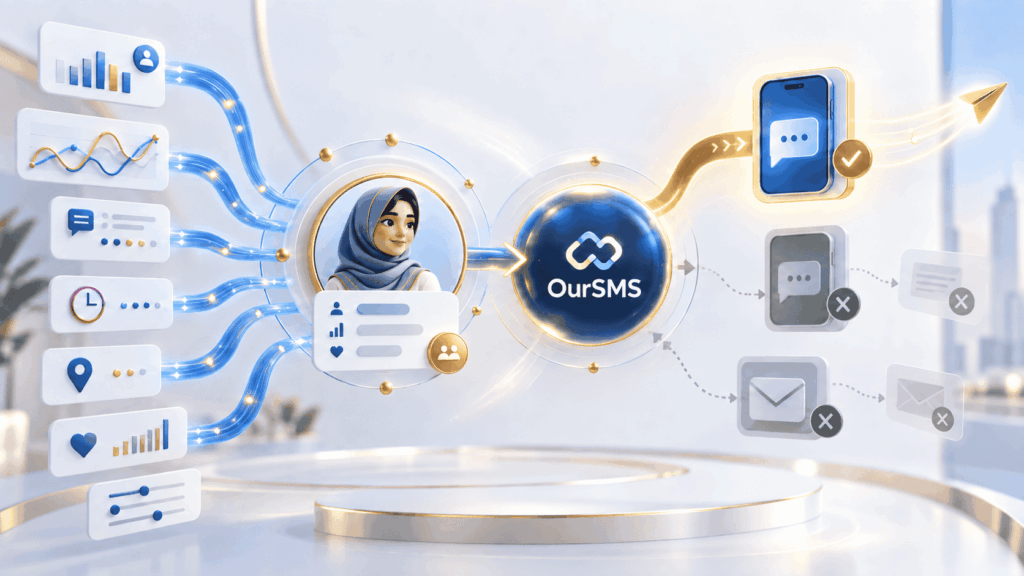
This is why SMS and WhatsApp should operate as parts of one communication strategy, rather than two independent campaign engines.
Do Not Make SMS and WhatsApp Compete
Imagine a retailer running an offer that ends Thursday evening.
Instead of broadcasting both SMS and WhatsApp to every customer, the company could route communication according to engagement and preference.
Customers who actively engage on WhatsApp can receive the WhatsApp campaign.
Other eligible customers may be reached through another appropriate channel according to the company’s communication strategy and permissions.
Most importantly, once a customer completes the purchase, they should automatically exit the reminder journey.
Otherwise, automation creates one of the worst customer experiences:
asking someone to buy something they have already purchased.
How Often Should You Send?
There is no universal number.
A restaurant and an insurance company should not have the same cadence.
A weekly shopper and a customer who buys once per year should not be treated identically either.
Instead of asking:
“Should we send twice or four times per week?”
Ask:
“Do we have something new and genuinely useful to communicate?”
Businesses can implement internal frequency caps that limit how many promotional messages an individual receives during a defined period.
Those limits can then adapt to engagement.
A customer who regularly opens, clicks, and purchases represents a very different communication profile from a customer who ignored the last six campaigns.
Segment Instead of Broadcasting
Segmentation is one of the most effective ways to reduce message fatigue.
Instead of treating 100,000 contacts as one audience, businesses can create segments such as:
recent customers,
inactive customers,
customers interested in a specific product category,
abandoned-cart users,
VIP customers,
and customers who engaged with a recent campaign.
Each segment receives communication that has a stronger reason to be relevant.
That is far more sustainable than sending “20% off everything” to the entire database every few days.
Use Customer Behavior as a Trigger
Good automation should not be based only on the marketing calendar.
It can react to customer behavior.
Abandoned cart → reminder.
Product back in stock → alert interested customers.
Subscription approaching renewal → renewal reminder.
Purchase completed → stop product reminders.
Repeated lack of engagement → reduce promotional frequency.
The result is a messaging strategy driven by events and intent, not simply by the fact that a campaign exists.
SMS or WhatsApp?
SMS is useful for concise, time-sensitive communication that does not require a rich conversational experience.
WhatsApp Business API can support richer interactions, buttons, media, and conversational journeys.
But channel selection should also account for customer preference and behavior.
The goal is not to use every available channel.
It is to use the minimum number of channels required to achieve the communication objective.
Know When to Stop
Knowing when not to send is an important marketing skill.
If a customer repeatedly fails to engage, consider reducing the cadence.
If they opt out of promotional messages, respect that decision.
If they have completed the conversion, remove them from the reminder journey.
WhatsApp users can provide feedback on business marketing messages or disable this category of communication, and repeated policy violations can result in increasingly serious messaging restrictions.
Stopping at the right time is part of campaign optimization.
What About SMS in Saudi Arabia?
Saudi Arabia’s Communications, Space & Technology Commission maintains regulations governing SMS services and regulations aimed at reducing spam and intrusive communications.
CST also explains that promotional SMS messages use a sender tag ending with -AD to identify the advertising nature of the message, and provides mechanisms for individuals to report intrusive messages.
Message quality therefore matters for more than conversion rates.
It is also connected to customer trust, regulatory requirements, and responsible use of direct communication channels.
Which Metrics Matter?
Do not judge campaign performance only by the number of messages sent.
Monitor delivery, read rates when available, click-through rates, conversions, opt-outs, complaints, and completed customer actions.
Another useful metric is often overlooked:
messages required per conversion.
If an older campaign generated a sale after two messages while the new strategy requires seven, increased messaging volume may be hiding declining efficiency.
Common Mistakes
One mistake is sending the same campaign through SMS and WhatsApp at the same time without a clear reason.
Another is sending every promotion to the entire database.
Businesses also make the mistake of maintaining the same messaging frequency for customers who consistently fail to engage.
Failing to update customer journeys after a purchase is another common automation issue.
Finally, businesses should not treat every unsubscribe as something to prevent at all costs.
A smaller audience that genuinely wants your communication can be more valuable than a massive list that ignores it.
How Can OurSMS Help?
OurSMS provides SMS, SMS API, and WhatsApp Business API solutions for businesses in Saudi Arabia, with integration capabilities for CRM systems, e-commerce platforms, ERP systems, and business applications.
According to the OurSMS company profile, API and SMPP integrations can connect messaging with business systems, enabling workflows based on customer data and system events rather than purely manual broadcasting.
OurSMS also provides contact management, SMS scheduling, and delivery reporting capabilities that can support more structured campaign management.
Conclusion
In business messaging, delivery is not the final objective.
If ten messages reach the customer’s phone and none of them feel relevant, the campaign is not successful simply because delivery reports look good.
The goal is to create a relationship in which customers expect communication because it is useful, relevant, and appropriately timed.
In 2026, one of the smartest messaging decisions a company can make may sometimes be:
“We don’t need to send another message today.”
Because better messaging is not about sending more.
It is about knowing which messages deserve to be sent at all.